
MPA Content Security v5.3.1 and Penetration Testing Requirements
An authoritative guide to Motion Picture Association (MPA) Content Security Best Practices v5.3.1, Trusted Partner Network (TPN) governance, the four-tier Shield system, and penetration testing mandates (Control TS-4.1) across the entertainment supply chain.
- Target Audience
- Production studios, VFX/CGI facilities, post-production houses, sound stages, localization vendors, cloud rendering farms, and media software developers
- Mandatory Frequency
- At least annually and after any significant application or infrastructure change
- Required Scope
- External IPs, public hosts, web applications, APIs, content transfer tools (Aspera and Signiant), cloud assets, remote worker access, and network segmentation
- Non-Compliance Risk
- Pre-release content leaks, vendor disqualification by major studios, loss of TPN Shield standing, and contract termination
Understanding MPA and Trusted Partner Network governance
The Motion Picture Association and Trusted Partner Network establish baseline cybersecurity standards to prevent leaks of pre-release film, television, and streaming assets.
- The MPA represents seven major studios: Walt Disney Studios, Netflix, Paramount Pictures, Prime Video and Amazon MGM Studios, Sony Pictures Entertainment, Universal City Studios, and Warner Bros. Discovery.
- The Trusted Partner Network (TPN) is a wholly owned MPA content-security initiative that maintains shared benchmarks and reduces assessment duplication across the supply chain.
- Applicable service providers span production sets, visual effects (VFX) facilities, post-production edit suites, sound engineering studios, dubbing and localization vendors, cloud rendering providers, and media software platforms.
- The centralized TPN+ Registry allows content owners to evaluate vendor security posture and readiness before authorizing the transfer of high-value digital assets.
The next-generation four-tier TPN Shield framework
TPN Shield status communicates preparedness and remediation progress for Content Owners to use in their vendor-risk decisions.
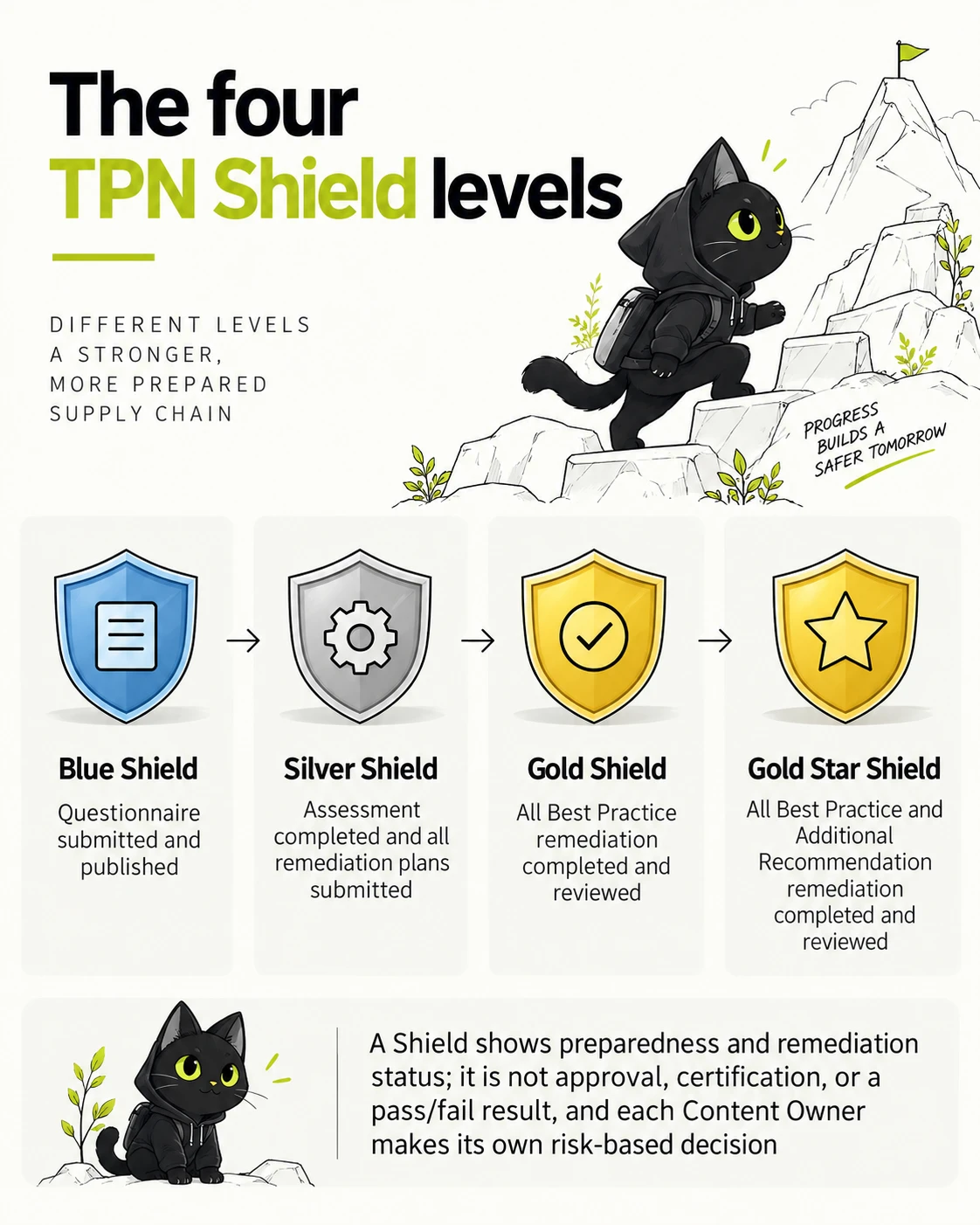
A Shield shows preparedness and remediation status; it is not approval, certification, or a pass/fail result, and each Content Owner makes its own risk-based decision
- Blue Shield — Questionnaire submitted and published
- Silver Shield — Assessment completed and all remediation plans submitted
- Gold Shield — All Best Practice remediation completed and reviewed
- Gold Star Shield — All Best Practice and Additional Recommendation remediation completed and reviewed
- Blue Shield follows submission and publication of the questionnaire and should be updated annually.
- Silver Shield follows assessment completion and submission of remediation plans for every applicable control or component.
- Gold Shield follows completion and review of all Best Practice remediation.
- Gold Star Shield follows completion and review of both Best Practice and Additional Recommendation remediation.
- Silver, Gold, and Gold Star remain valid for two years from report publication, but a Shield is not approval, certification, or a pass/fail result.
Control TS-4.1 penetration testing versus TS-4.0 vulnerability scanning
The v5.3.1 workbook separates TS-4.0 vulnerability scanning from TS-4.1 penetration testing and gives each process distinct scope, cadence, tester, and remediation expectations.
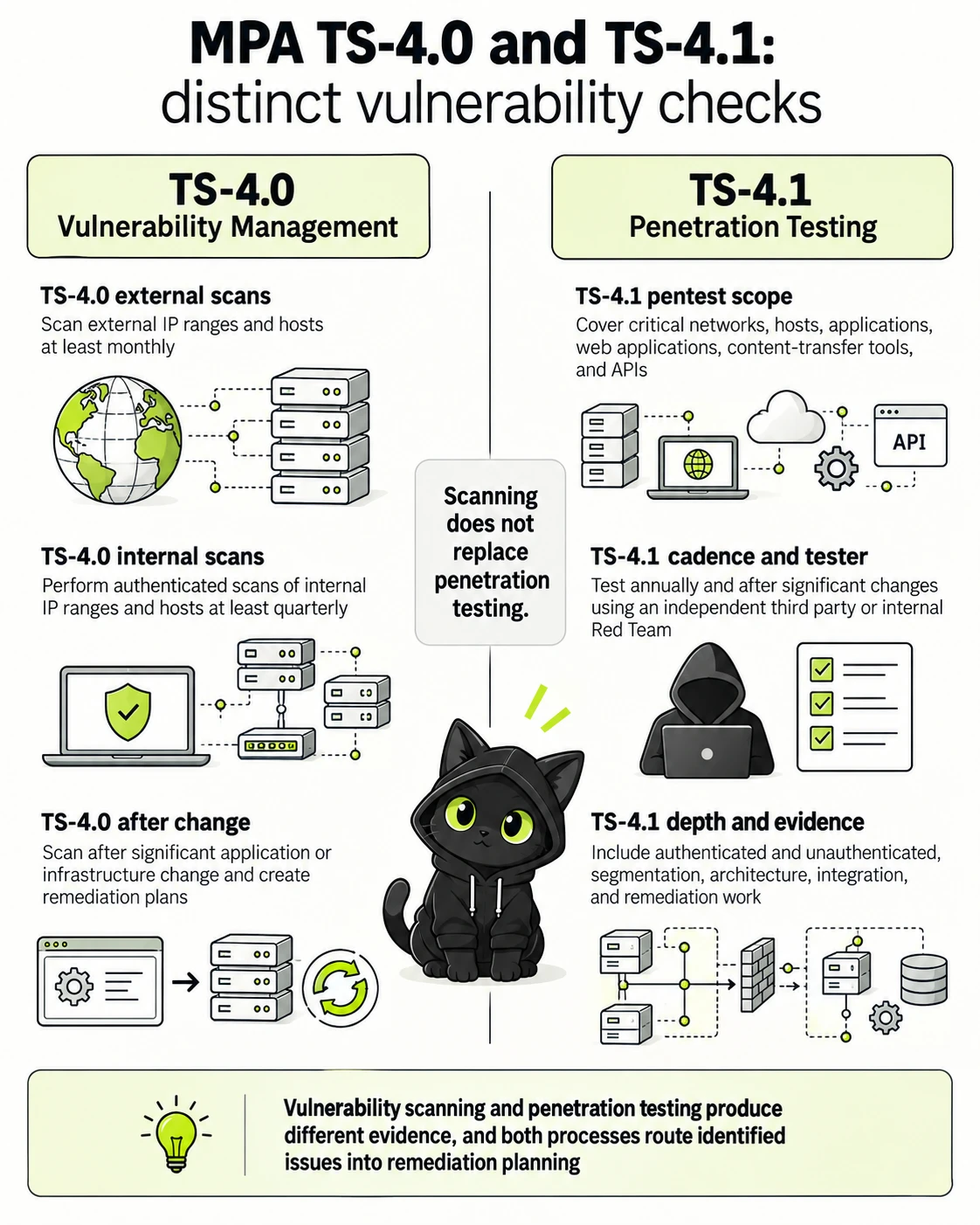
Vulnerability scanning and penetration testing produce different evidence, and both processes route identified issues into remediation planning
- TS-4.0 external scans — Scan external IP ranges and hosts at least monthly
- TS-4.0 internal scans — Perform authenticated scans of internal IP ranges and hosts at least quarterly
- TS-4.0 after change — Scan after significant application or infrastructure change and create remediation plans
- TS-4.1 pentest scope — Cover critical networks, hosts, applications, web applications, content-transfer tools, and APIs
- TS-4.1 cadence and tester — Test annually and after significant changes using an independent third party or internal Red Team
- TS-4.1 depth and evidence — Include authenticated and unauthenticated, segmentation, architecture, integration, and remediation work
- TS-4.0 calls for external scans at least monthly, authenticated internal scans at least quarterly, and scans after significant application or infrastructure change.
- TS-4.0 covers content and production networks, non-production networks, and APIs, with investigation and remediation planning.
- TS-4.1 covers critical network segments, hosts, applications, web applications, content-transfer tools, and APIs, with testing annually and after significant changes.
- TS-4.1 uses an independent third party or internal Red Team; third parties hold relevant certification such as GPEN, OSCP, or CEH.
- TS-4.1 includes authenticated and unauthenticated, segmentation, application and network architecture, integration, and remediation work.
Application security, cloud infrastructure, and remote working scope
Version 5.3.1 deepens application security scrutiny while addressing distributed post-production workflows and hybrid cloud deployments.
- Application security assessments evaluate the secure development lifecycle (SSDLC), SAST, DAST, and third-party software dependencies across custom tools and plugins.
- Control PS-4.2 requires testing to cover infrastructure in data centers, colocation facilities, and public cloud providers within the vendor's scope of responsibility.
- Control TS-2.9 extends testing requirements to work-from-home (WFH) endpoints and remote access gateways, including VPN and Zero Trust Network Access (ZTNA) solutions.
- Network segmentation testing is mandatory to prove that production content storage and editing networks are segregated from general corporate and guest networks.
- Version 5.3 introduced targeted controls for artificial intelligence and machine learning pipelines to safeguard training datasets, prompts, and synthetic media models.
Remediation workflows and audit evidence for Gold Shield qualification
Receiving a penetration test report is only the baseline. Earning a TPN Gold Shield requires verified remediation evidence reviewed by TPN SecOps.
- Establish a formal remediation plan immediately upon report receipt, prioritizing containment of critical vulnerabilities within 24 to 48 hours.
- Perform independent retesting to obtain written verification that identified vulnerabilities have been effectively remediated.
- Submit remediation evidence through the TPN+ platform for review and approval by TPN SecOps to elevate standing to Gold or Gold Star Shield status.
- Connect technical test findings to wider ISMS risk treatment workflows under ISO/IEC 27001 or NIST to provide executive transparency into residual risk.
Requirements and Testing Scope Matrix
Summary of the referenced clauses, the testing scope they cover, and the expected evaluation cycle.
| Reference | Mandate Title | Scope Required | Testing Cycle |
|---|---|---|---|
| Control TS-4.1 | Annual Penetration Testing | Penetration testing of external IPs, public hosts, web applications, APIs, file transfer tools (Aspera and Signiant), and network segmentation with authenticated and unauthenticated methods | At least annually and after significant application or infrastructure changes |
| Control TS-4.0 | Vulnerability Management and Scanning | External and internal authenticated vulnerability scanning across hosts, virtual machines, containers, and APIs | Monthly for external systems, quarterly for internal systems, and after major changes |
| Control PS-4.2 & TS-2.9 | Data Center, Cloud Infrastructure, and Remote Working Scope | Testing across data centers, colocation facilities, cloud service providers, and remote worker, VPN, or ZTNA access points | Annually and whenever remote access gateways or cloud architectures are updated |
| TPN Application Security Controls | Application Security and Software Supply Chain | Secure SDLC verification, SAST, DAST, software dependency reviews, and AI/ML data protections | Prior to major application releases and during TPN+ assessment cycles |
Compliance Readiness Self-Assessment
Select items your organization has completed to evaluate your readiness score.
Frequently Asked Questions (FAQ)
Key answers and practical guidance addressing common compliance questions.
Does a TPN assessment award a pass or fail certification?
No. TPN assessments do not issue pass or fail ratings. Assessors produce an objective conformance report against MPA Best Practices. Studio content owners evaluate the report, open remediation items, and TPN Shield status in the TPN+ Registry to make their own procurement decisions.
Can automated vulnerability scanning satisfy the penetration testing requirement in TS-4.1?
No. The MPA framework explicitly treats them as distinct controls. TS-4.0 governs regular automated vulnerability scans, while TS-4.1 mandates manual, adversary-simulated penetration testing by an independent third party to uncover complex business logic and privilege escalation flaws.
What happens to service providers holding a Classic Gold Shield under the new system?
Existing Classic Gold Shields remain valid until their two-year assessment report expires, but they do not reflect verified remediation progress. When providers renew under v5.3.1, they transition to the four-tier framework and must resolve all Best Practice remediation items to achieve Gold Shield status.