
Penetration Testing under ISO/IEC 27001:2022 Requirements
ISO/IEC 27001:2022 establishes an Information Security Management System (ISMS) where technical vulnerability assessments and penetration testing validate control effectiveness under Annex A.8.8 and empower core ISMS risk processes.
- Target Audience
- Organizations certified under ISO/IEC 27001:2022 or establishing an ISMS
- Mandatory Frequency
- Determined by risk assessment and major changes (Risk-based Cadence), reviewed before annual Surveillance Audits
- Required Scope
- In-scope ISMS assets, cloud infrastructure, production systems, and critical services defined in the SoA
- Non-Compliance Risk
- Major or Minor Non-Conformity (NC) findings for unmanaged vulnerabilities, leading to certificate suspension
Operationalizing Security Test Evidence under ISO/IEC 27001:2022
ISO/IEC 27001:2022 establishes an Information Security Management System (ISMS) where penetration testing delivers maximum value when integrated into scoping, risk treatment, control ownership, and continual improvement.
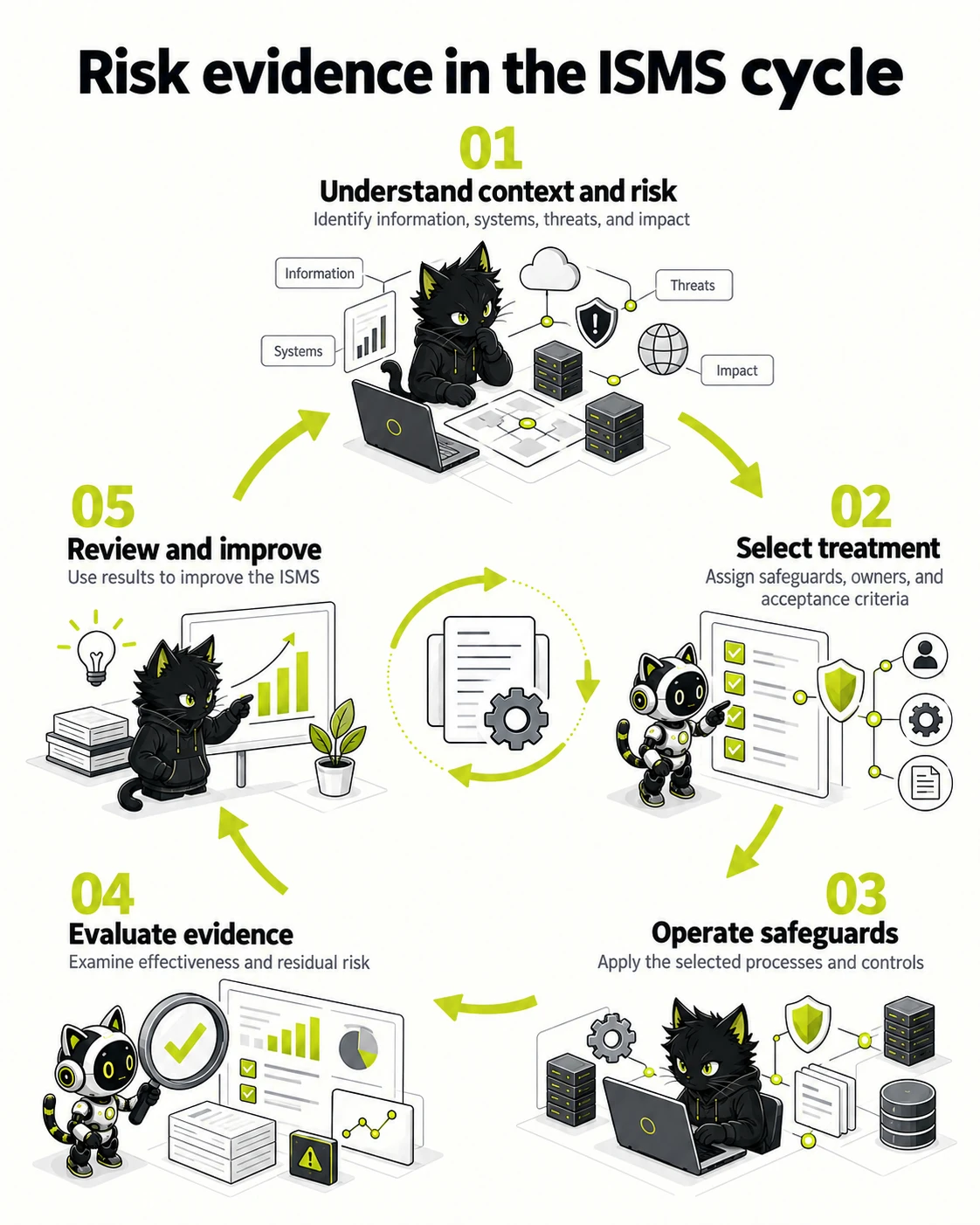
Test results become useful when they feed risk treatment and ISMS improvement.
- Understand context and risk — Identify information, systems, threats, and impact
- Select treatment — Assign safeguards, owners, and acceptance criteria
- Operate safeguards — Apply the selected processes and controls
- Evaluate evidence — Examine effectiveness and residual risk
- Review and improve — Use results to improve the ISMS
- Distinguish technical flaws under ISO/IEC 27000:2018 (Clause 3.77) from human error, addressing architectural and systemic weaknesses under Annex A.8 rather than assigning individual blame
- Directly feed vulnerability assessment and pentest results into core ISMS clauses: risk identification (Clause 6.1.2 / 8.2), risk treatment (Clause 6.1.3 / 8.3), and management review (Clause 9.3)
- Clarify audit realities: identifying vulnerabilities during testing is NOT an automatic Non-Conformity (NC), but evidence that A.8.8 works; NCs stem from unmanaged flaws or lack of re-test verification
- Orchestrate complementary technical controls across asset inventory (A.5.9), threat intelligence (A.5.7), configuration management (A.8.9), and pre-go-live acceptance testing (A.8.29)
- Prioritize remediation using threat-informed intelligence by correlating CISA KEV, EPSS scores, and asset exposure context rather than relying solely on raw CVSS metrics
ISO/IEC 27001:2022 / ANNEX A.8.8 REQUIREMENTS
Technical Vulnerability Management & Penetration Testing Requirements (Annex A.8.8)
Annex A Control A.8.8 in ISO/IEC 27001:2022 mandates obtaining timely information about technical vulnerabilities, evaluating exposure, and executing appropriate mitigating measures.
- Risk-Based Testing Cadence: ISO/IEC 27001:2022 does not impose rigid universal intervals; assessment frequency is governed by asset criticality, threat surface changes, and organizational risk tolerance.
- Penetration Testing as Empirical Evidence: While vulnerability scanning identifies theoretical weaknesses, penetration testing simulates active attacker tactics to validate whether technical controls genuinely withstand exploitation.
- Alignment with Statement of Applicability (SoA): When A.8.8 and A.8.29 are declared in scope within the SoA, the organization must demonstrate defined identification processes, remediation SLAs, and assigned control owners.
- Remediation SLAs and Compensating Controls: Security policy must establish explicit remediation timelines stratified by severity, requiring compensating controls where immediate patching is unfeasible.
- Independent Retest Verification: Remediation efforts must be validated through technical re-testing to provide objective proof that vulnerabilities are closed without introducing side-channel weaknesses.
Penetration testing under ISO 27001 is not a superficial check-the-box audit exercise; it provides empirical proof of control effectiveness directly feeding into organizational risk treatment.
OFFENSIVE PERSPECTIVE / ATTACK SURFACE
Technical Vulnerabilities as Systemic Weaknesses, Not Personnel Failures
From an offensive testing perspective and international standards definition, vulnerabilities represent technical and architectural flaws requiring systematic mitigation, not human disciplinary fault.
- Canonical Definition under ISO/IEC 27000:2018 (Clause 3.77): A vulnerability is defined strictly as a weakness of an asset or control that can be exploited by one or more threats, with zero reference to personal fault or employee negligence.
- Structural Annex A Themes: ISO/IEC 27001:2022 structures controls into 4 distinct themes, categorizing vulnerability management under A.8 (Technological controls) rather than A.6 (People controls).
- Active 2026 CISA KEV Example: Remote Code Execution (RCE) flaws in Fortinet FortiOS / SSL-VPN appliances listed in CISA KEV demonstrate how external threat actors target perimeter appliances directly via architectural exposure, irrespective of staff discipline.
- Counteracting Blame Culture: Treating vulnerability discovery as personnel wrongdoing incentivizes hiding risks and avoiding deep security testing, critically weakening enterprise cyber resilience.
Vulnerability management under Annex A.8.8 must prioritize engineering hygiene, architectural hardening, and transparent disclosure over assigning blame.
AUDIT & GOVERNANCE / NON-CONFORMITY REALITIES
Audit Interpretation: Finding Vulnerabilities is Not a Non-Conformity (NC)
Uncovering vulnerabilities during technical assessments demonstrates functional detection controls; audit non-conformities arise from neglected governance and unmanaged risks.
- Finding Flaws Demonstrates Control Operation: Documented findings in a pentest report serve as empirical evidence that the organization's identification mechanisms under Control A.8.8 are operational.
- Actual Root Causes of Non-Conformities (NC): Audit NCs stem from: 1) Absence of defined vulnerability management procedures, 2) Ignoring known flaws without risk assessment, 3) Breaching remediation SLAs without documented risk acceptance, or 4) Closing tickets without validation.
- Legitimate Risk Acceptance under Clauses 6.1.3 & 8.3: When immediate remediation is constrained by business dependencies, establishing compensating controls alongside formal management risk acceptance prevents audit findings.
- Criticality of Retest Evidence: Auditors require verifiable proof of remediation; an independent Retest report constitutes essential evidence of closure for technical findings.
ISMS auditors do not expect a vulnerability-free environment; they evaluate whether the organization possesses a repeatable, accountable process for discovering, assessing, and remediating technical risk.
ISMS INTEGRATION / CLAUSES 6, 8, 9, 10
Bring test results back into the ISMS
Technical test results must not remain isolated within PDF reports; they must feed directly into the core management clauses of the ISMS to drive continual security improvement.
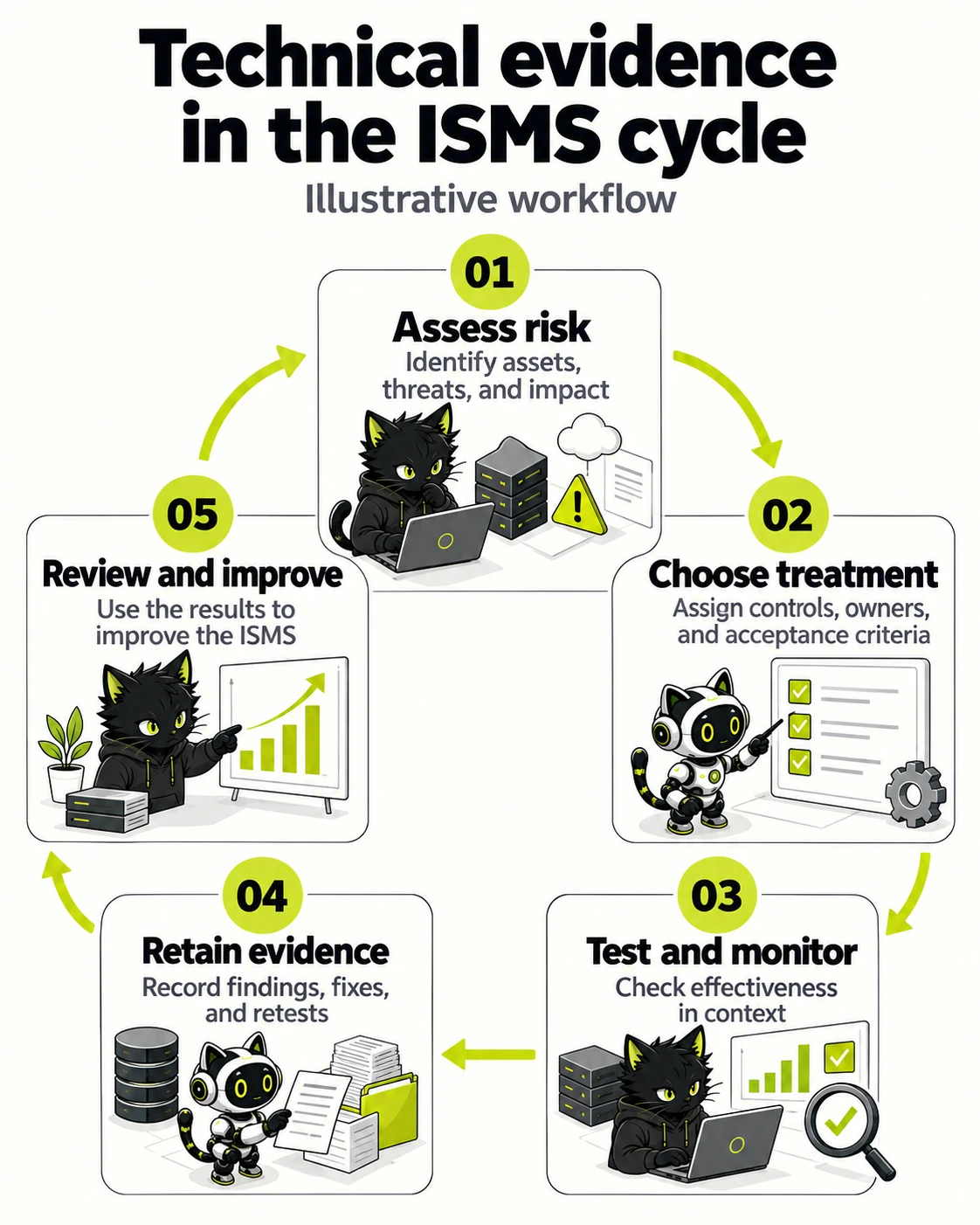
An illustrative ISMS workflow: link each finding to risk and an owner, retain remediation and retest evidence, and take the remaining risk into the next review.
- Assess risk — Identify assets, threats, and impact
- Choose treatment — Assign controls, owners, and acceptance criteria
- Test and monitor — Check effectiveness in context
- Retain evidence — Record findings, fixes, and retests
- Review and improve — Use the results to improve the ISMS
- Clauses 6.1.2 & 8.2 (Information Security Risk Assessment): Penetration testing yields empirical threat-feasibility data, replacing subjective guesswork when evaluating exploit likelihood and business impact in the Risk Register.
- Clauses 6.1.3 & 8.3 (Information Security Risk Treatment): Every technical finding maps to a defined risk treatment decision—mitigation via patching/hardening, risk avoidance, risk transfer, or formal documented risk acceptance.
- Clauses 9.1 & 9.3 (Monitoring, Measurement & Management Review): Technical metrics including Mean Time to Remediate (MTTR), recurring finding frequency, and retest success rates serve as mandatory inputs to executive Management Reviews.
- Clauses 10.1 & 10.2 (Nonconformity, Corrective Action & Continual Improvement): Systemic or repeat vulnerabilities trigger formal Root Cause Analysis (RCA) to eliminate architectural flaws and enhance the secure development lifecycle (A.8.25-A.8.29).
Embedding offensive findings into Clauses 6, 8, 9, and 10 transforms technical discoveries into executive risk governance, proving that the ISMS operates as a living, mature management system.
THREAT-INFORMED DEFENSE / RISK-BASED REMEDIATION
Threat-Informed Vulnerability Prioritization Beyond Raw CVSS
Relying exclusively on base CVSS scores creates operational bottlenecks; organizations must apply threat-informed triage combining active exploitation feeds (Annex A.5.7) and asset architecture.
- Limitations of Raw CVSS Metrics: Base CVSS calculates theoretical severity in an idealized vacuum, triggering overwhelming patch queues for complex vulnerabilities that lack functional in-the-wild exploit code.
- Operationalizing CISA KEV Feeds: Vulnerabilities listed in CISA's Known Exploited Vulnerabilities catalog (such as active Fortinet perimeter appliance RCEs) demand immediate emergency response, as weaponization is already verified.
- Statistical Triage via EPSS: Applying the Exploit Prediction Scoring System estimates the empirical probability of real-world exploitation within 30 days, focusing engineering bandwidth on active attack surfaces.
- Contextual Asset Exposure: Internet-facing gateways, external APIs, and critical data stores warrant higher triage priority than isolated internal tiers guarded by robust segmentation and defense-in-depth controls.
- Execution of ISO 27001 Risk Principles: Integrating threat intelligence (A.5.7) with vulnerability management (A.8.8) directly satisfies Clause 6.1.2 risk assessment mandates, ensuring resource allocation targets genuine operational risk.
Threat-informed prioritization replaces reactive, indiscriminate patching with targeted attack-surface reduction, optimizing remediation speed where weaponized threats pose immediate business danger.
Requirements and Testing Scope Matrix
Summary of the referenced clauses, the testing scope they cover, and the expected evaluation cycle.
| Reference | Mandate Title | Scope Required | Testing Cycle |
|---|---|---|---|
| Annex A 8.8 | Management of Technical Vulnerabilities | In-scope ISMS assets, cloud infrastructure, and network perimeters | Risk-based cadence, re-evaluated each Surveillance Audit cycle |
| Annex A 8.29 | Security Testing in Development and Acceptance | New application builds, major service updates, and pre-production releases | Prior to production go-live and following significant structural changes |
| Annex A 5.9 | Inventory of Information and Other Associated Assets | Hardware, software, cloud services, and external interfaces within ISMS scope | Continuously maintained and validated prior to security assessments |
| Annex A 8.9 & A.8.32 | Configuration Management and Change Management | Operating systems, databases, network gear, and remediation patch deployments | Enforce security baselines and review upon configuration changes or patch releases |
| Annex A 5.7 | Threat Intelligence | Active exploitation feeds (CISA KEV, EPSS) integrated into vulnerability scoring | Continuously monitored and correlated with enterprise asset exposure |
| Annex A 5.35 | Independent Review of Information Security | Security controls and technical vulnerability processes declared in the SoA | Planned intervals by independent, qualified external security practitioners |
Compliance Readiness Self-Assessment
Select items your organization has completed to evaluate your readiness score.
Frequently Asked Questions (FAQ)
Key answers and practical guidance addressing common compliance questions.
Which ISO/IEC 27001:2022 controls govern vulnerability assessments and penetration testing?
The primary control is Annex A Control A.8.8 (Management of technical vulnerabilities), which requires identifying and addressing technical weaknesses. Complementary controls include Control A.8.29 (Security testing in development and acceptance), Control A.5.9 (Inventory of assets), Control A.5.7 (Threat intelligence for risk prioritization), and Control A.5.35 (Independent review of information security).
Does discovering a Critical vulnerability during penetration testing constitute an automatic Non-Conformity (NC)?
No. Finding a vulnerability is empirical proof that the identification mechanism under Control A.8.8 functions effectively. A Non-Conformity arises only if the organization lacks a defined vulnerability management process, ignores known flaws beyond established remediation SLAs without formal risk acceptance under Clause 6.1.3/8.3, or closes findings without rigorous re-testing (Retest) validation.
How do technical test findings integrate into core ISMS management clauses (Clauses 4-10)?
Test findings provide quantitative input into risk assessment (Clauses 6.1.2 and 8.2) and dictate risk treatment actions (Clauses 6.1.3 and 8.3). Key performance metrics—such as Mean Time to Remediate (MTTR) and re-test pass rates—are evaluated during Management Review meetings (Clause 9.3). Systemic or recurring flaws trigger root-cause analysis and corrective actions under Continual Improvement (Clauses 10.1 and 10.2).
Why should modern ISO/IEC 27001 vulnerability prioritization look beyond raw CVSS scores?
Base CVSS scores represent theoretical severity without reflecting active real-world threat dynamics. Modern risk-informed prioritization correlates vulnerability data with Threat Intelligence (Annex A.5.7)—specifically CISA KEV (Known Exploited Vulnerabilities) and EPSS probabilities—alongside actual asset exposure (internet-facing vs isolated internal systems) to remediate weaponized risks first.