
What ISO/IEC 42001:2023 means and how AI pentesting proves AIMS readiness
Policies alone do not prove that production AI is safe. This page explains ISO/IEC 42001:2023 and ISO/IEC 23894:2023, then shows how AI pentesting and red teaming produce decision-ready evidence for management and auditors.
- Target Audience
- Organizations developing, deploying, or utilizing AI systems across business processes
- Mandatory Frequency
- Before go-live, after significant change, and at intervals defined by the Risk Treatment Plan
- Required Scope
- AIMS, AI inventory, data, models, applications, agents, third parties, and controls selected in the SoA
- Non-Compliance Risk
- Audit nonconformities, weak control evidence, exploitable AI paths, and hidden residual risk
How the AIMS improvement cycle works
ISO/IEC 42001:2023 is a management-system standard for organizations that develop, provide, or use AI. It connects governance, risk, and evidence through the Plan-Do-Check-Act cycle.
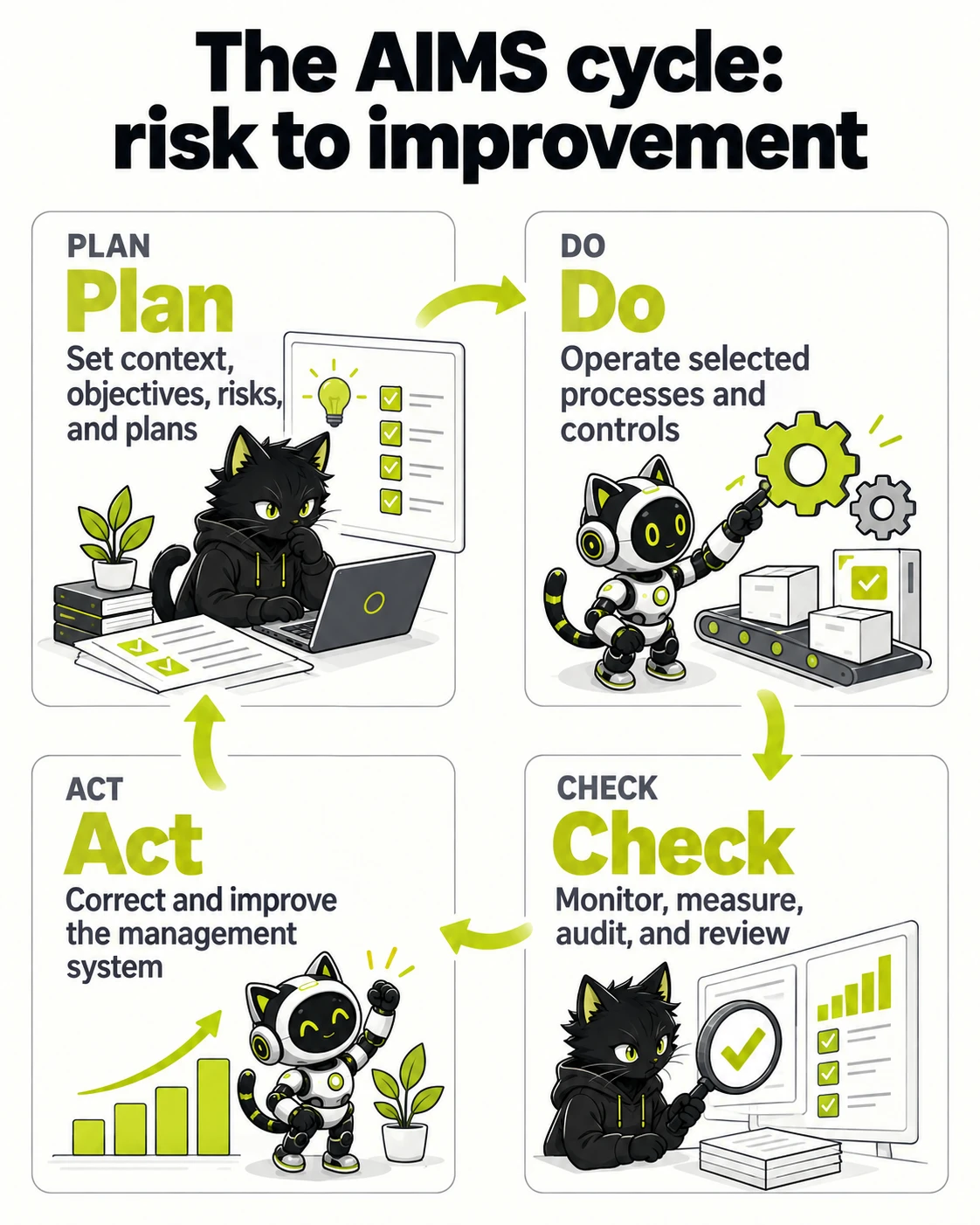
Operating evidence feeds the next review. The aim is a management system that handles risk better, with decisions carried into the next planning cycle.
- Plan — Set context, objectives, risks, and plans
- Do — Operate selected processes and controls
- Check — Monitor, measure, audit, and review
- Act — Correct and improve the management system
- Clauses 4 to 10 cover organizational context, leadership, planning, support, operation, performance evaluation, and improvement through the ISO Harmonized Structure.
- Clauses 6.1.2 and 6.1.3 establish AI risk assessment and treatment processes, including the Risk Treatment Plan and a Statement of Applicability that justifies selected controls.
- Clauses 8.2 to 8.4 turn risk assessment, treatment, and impact assessment into operational activities performed at planned intervals and after significant change.
- The standard does not certify that a model is automatically secure. A credible AIMS links policy, control owners, acceptance criteria, and evidence from the real system.
How Annex A turns AI risks into auditable controls
Annex A provides 38 reference controls across nine groups from A.2 to A.10. Organizations select controls from risk, justify inclusions and exclusions in the SoA, and demonstrate that selected controls work.
- A.5 addresses AI-system impacts on individuals, groups, and society. ISO/IEC 42005:2025 is a complementary guide for performing structured impact assessments.
- A.6 covers development objectives, requirements, verification, deployment, operation, monitoring, technical documentation, and event logging across the AI lifecycle.
- A.7 covers data management, selection, quality, provenance, and preparation, which underpin data-poisoning defense and bias evaluation.
- A.10 addresses customers, suppliers, and third parties, so assurance should include model APIs, cloud AI, datasets, plugins, and dependencies outside direct control.
How ISO/IEC 23894 reveals risks that generic checklists miss
ISO/IEC 23894:2023 guides organizations that develop, produce, deploy, or use AI systems and helps integrate AI risk management into normal organizational activities.
- Start with context, intended use, stakeholders, and impacts before selecting metrics. A single vulnerability score cannot replace safety, privacy, bias, and business-impact analysis.
- Consider opacity, data quality, model drift, fine-tuning changes, human oversight, and external dependencies that can create new risk.
- Record assumptions, limitations, risk owners, acceptance criteria, and residual risk so test results can support release and management decisions.
- Use ISO/IEC 23894 as adaptable guidance within an AIMS. It is not a separate certification scheme.
Why AI pentesting and red teaming are strong AIMS evidence
ISO/IEC 42001 does not prescribe one pentest method or fixed cadence. It does require risk management, effectiveness evaluation, and evidence. Independent testing is a credible way to prove technical-control performance.
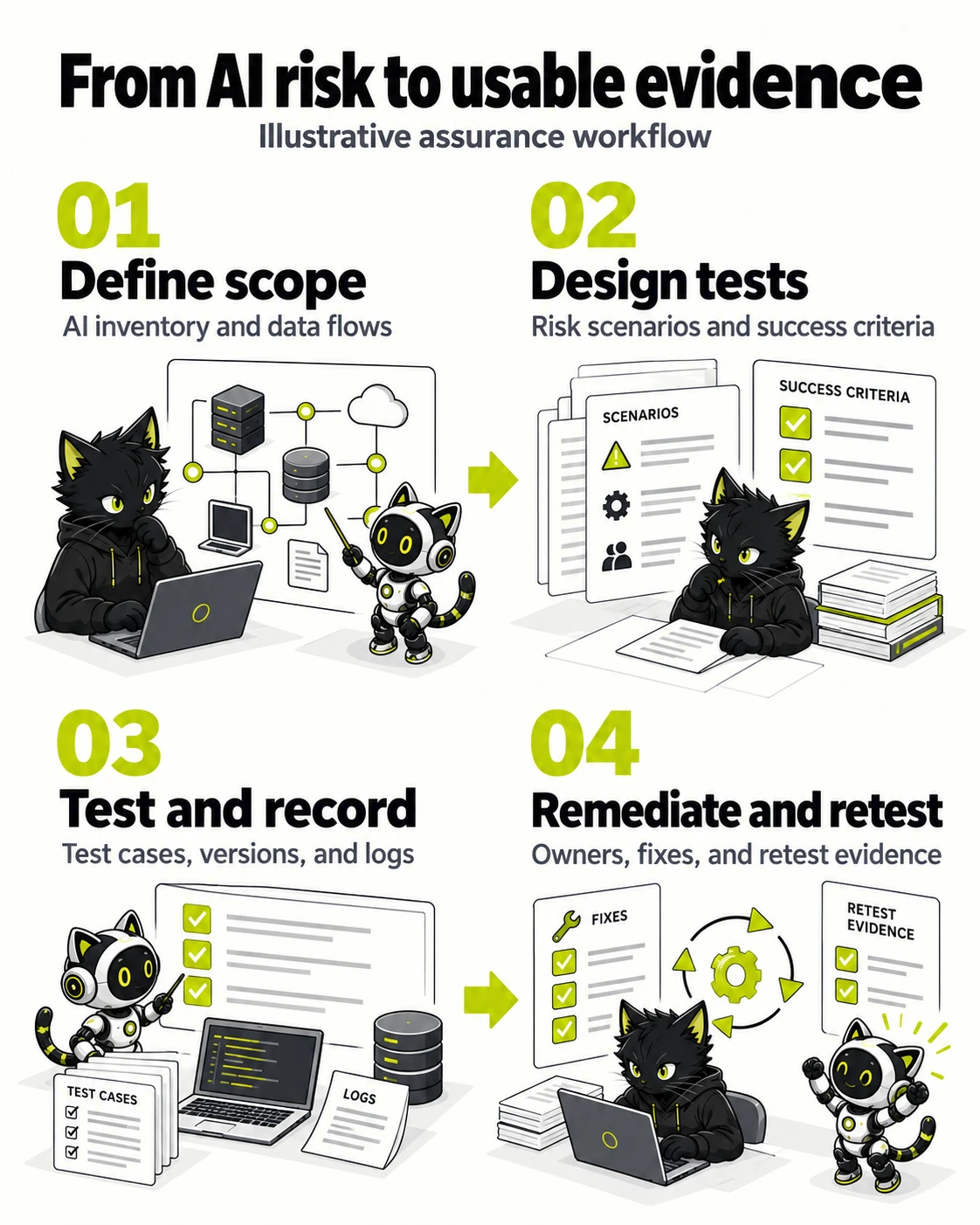
An illustrative assurance workflow: record system versions, test conditions, and reproducible results so the team can verify whether a fix actually reduced risk.
- Define scope — AI inventory and data flows
- Design tests — Risk scenarios and success criteria
- Test and record — Test cases, versions, and logs
- Remediate and retest — Owners, fixes, and retest evidence
- Test direct and indirect prompt injection, RAG poisoning, sensitive-data disclosure, model extraction, and guardrail bypass against the actual threat model.
- For agents, test least privilege, tool allowlists, human approval, credential scope, memory poisoning, output handling, and emergency-stop behavior.
- Retain test cases, prompts, model and dataset versions, success rates, severity, logs, and retest evidence so results are reproducible and auditable.
- Trigger testing before go-live and after meaningful changes to models, prompts, RAG sources, tools, agent permissions, or deployment architecture.
Evidence that supports management and audit decisions
A useful report goes beyond a vulnerability list. It shows which risk was tested, which control failed, who owns remediation, and whether residual risk after retest is acceptable.
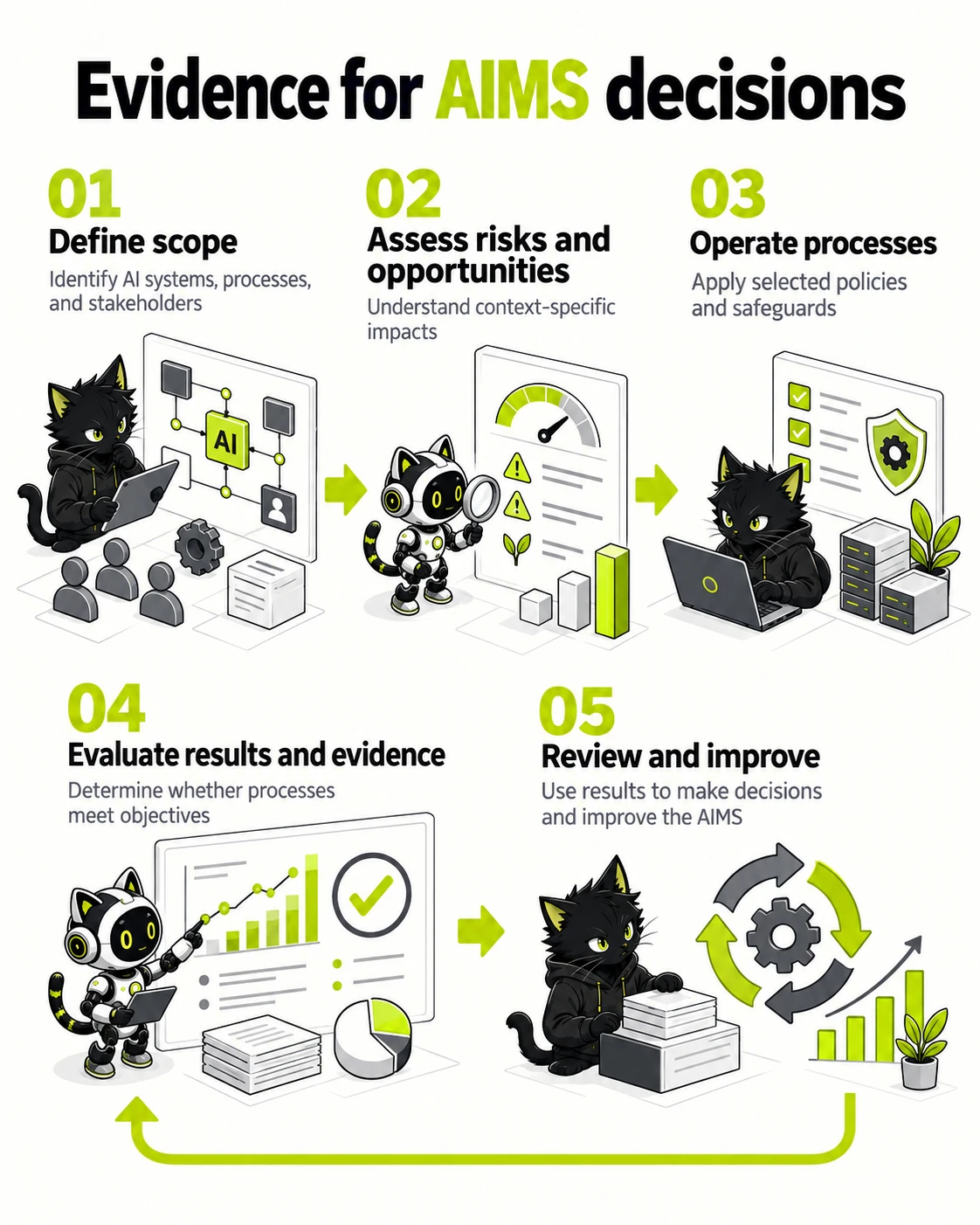
Evidence supports management decisions and continual AIMS improvement.
- Define scope — Identify AI systems, processes, and stakeholders
- Assess risks and opportunities — Understand context-specific impacts
- Operate processes — Apply selected policies and safeguards
- Evaluate results and evidence — Determine whether processes meet objectives
- Review and improve — Use results to make decisions and improve the AIMS
- Start with the AIMS scope, AI inventory, data flows, trust boundaries, model dependencies, users, and agent permissions so critical paths are not omitted.
- Map findings to the risk register, SoA, Risk Treatment Plan, impact assessment, and release criteria without claiming that one pentest establishes certification.
- Separate application, infrastructure, model, data, and agent findings, then state business impact and the demonstrated attack path.
- Close the loop with remediation owners, due dates, retest evidence, risk acceptance, and lessons returned to management review.
Requirements and Testing Scope Matrix
Summary of the referenced clauses, the testing scope they cover, and the expected evaluation cycle.
| Reference | Mandate Title | Scope Required | Testing Cycle |
|---|---|---|---|
| Clause 6.1.2 & 6.1.3 | AI risk assessment and risk treatment | Perform technical AI risk assessments and document formal Risk Treatment Plans | At planned intervals and after significant change under Clauses 8.2 and 8.3 |
| Annex A.6 | AI-system lifecycle controls | Define requirements, verification, validation, deployment, monitoring, technical documentation, and event logging | Before go-live and after changes to models, prompts, data, tools, or architecture |
| Clauses 9.1 and 10.2 | Effectiveness evaluation and corrective action | Define monitoring, measurement, evaluation criteria, and evidence that risk treatment or remediation is effective | Risk-based monitoring and retesting after remediation |
| Annex A.7 | Data governance and provenance verification | Evaluate data selection, quality, provenance, preparation, and data-poisoning risk | When data is acquired, prepared, changed, or used for training, fine-tuning, and RAG |
Compliance Readiness Self-Assessment
Select items your organization has completed to evaluate your readiness score.
Frequently Asked Questions (FAQ)
Key answers and practical guidance addressing common compliance questions.
Does ISO/IEC 42001 require AI penetration testing?
The standard does not prescribe one pentest method or cadence. It requires risk assessment, selected controls, effectiveness evaluation, and evidence. AI pentesting and red teaming are strong ways to demonstrate technical-control performance.
How do ISO/IEC 42001 and ISO/IEC 23894 differ?
ISO/IEC 42001 is a certifiable management-system requirements standard for an AIMS. ISO/IEC 23894 is adaptable guidance for managing AI risk and is not a separate certification scheme.
Does one penetration test make an organization ISO/IEC 42001 ready?
No. A pentest is one evidence source. Readiness also requires scope, policy, risk assessment, the SoA, impact assessment, monitoring, internal audit, management review, corrective action, and continual improvement.